


Осмотрите напольный киоск. Интерактивные сенсорные киоски — торговые центры, музеи и отели | Большой мультисенсорный экран для поиска товаров в розничной торговле, навигации и использования на выставках. → | Посмотрите интерактивный сенсорный киоск. Полноценный ассортимент киосков с сенсорным экраном | Напольные, настенные, двусторонние и работающие от батареек модели — в одном месте. → |
Просмотрите все киоски с сенсорными экранами.
Нашли подходящий вариант использования? Давайте определим характеристики оборудования.
Сообщите нам место проведения, размер экрана и количество устройств. Мы ответим в течение одного рабочего дня, предоставив информацию о ценах и рекомендуемую модель, разработанную специально для данной среды. | Электронная почта: irenepan@fj-imgs.com Телефон/WhatsApp: +86-18850151946 |
Отправить запрос | Просмотреть все товары |
~20% | Average order size lift McDonald’s reported after deploying self-order kiosks (Business Insider) |
25% | Higher upsells Mews hotels reported from check-in kiosks (Mews, 2025) |
1. Self-Order Screens in Quick-Service Restaurants
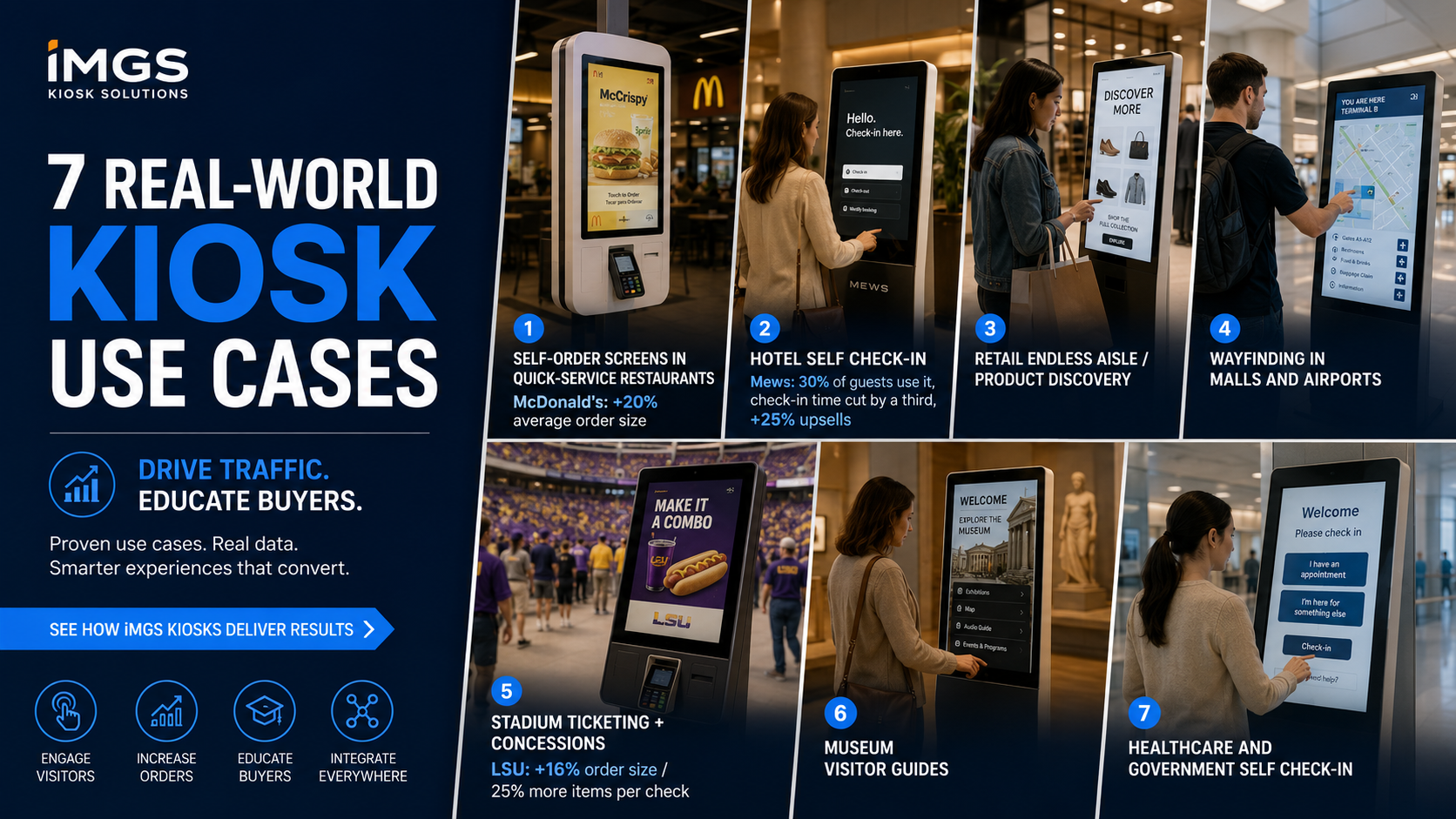
This is the use case everyone has seen. A touch screen kiosk at the entrance of a fast-food outlet lets diners browse the menu, customize, and pay without a queue. McDonald’s reported about a 20% rise in average order size after rollout, because the screen prompts every customer to add a drink or dessert with no awkward sales pitch. For QSR brands, a floor-standing touch screen kiosk pays for itself through upsells most cashiers forget to make.
There is a second payoff that buyers often miss. When orders move to the screen, staff shift from taking payments to preparing food and running orders to tables. The same headcount serves more covers per hour. A kiosk near the door also smooths the lunch rush, since several people order at once instead of forming one long line at a single till. For franchise operators rolling out across many sites, hardware consistency matters as much as the screen itself, so the unit needs to come from one supplier who can repeat the exact build.
2. Hotel Self Check-In and Concierge
Hospitality has embraced the touch screen kiosk fast. Mews reported that 30% of guests at its US hotels now check in via kiosk, cutting check-in time by a third and freeing front-desk staff to actually welcome people. The same kiosks drove 25% higher upsells, offering room upgrades and late checkout at the screen. A lobby touch screen kiosk handles arrivals, key-card issuing, and local recommendations, and it works at 2am when the desk is unstaffed.
Two practical features make or break a hotel deployment. First, multilingual interfaces, since guests arrive from everywhere and a screen that switches to their language removes friction a tired receptionist cannot always offer. Second, integration with the property management system so the kiosk can read a booking, charge a card, and print or encode a key without a staff member stepping in. A touch screen kiosk that covers both turns the lobby queue into a quiet, self-paced arrival.
3. Retail Product Discovery and Endless Aisle
When a store cannot stock every size or colour, an interactive advertising display lets shoppers browse the full catalogue and order out-of-stock items on the spot. This “endless aisle” turns a lost sale into a completed one. The same interactive advertising display doubles as a promotional screen between customers, running brand video and offers, so the hardware works whether someone is touching it or not. Retailers get a sales tool and an interactive advertising display in one unit.
The quiet benefit here is data. Every tap on the interactive advertising display tells the retailer what shoppers looked for, which sizes they wanted but could not find, and which promotions pulled attention. Tied to a loyalty sign-up on the same screen, that turns a passive store visit into first-party customer data, the kind that is getting harder to buy elsewhere. Placed at the entrance, the screen pulls foot traffic in; placed by the fitting rooms, it recovers sales that would otherwise walk out the door.
4. Wayfinding in Malls, Airports and Campuses
Large venues use a touch screen kiosk to answer the one question every visitor has: where is it? Interactive maps, store directories, and step-by-step routing reduce staff interruptions and frustrated guests. Between searches, the screen runs as an interactive advertising display, selling premium ad slots to the tenants whose stores it points toward. Wayfinding plus advertising on one touch screen kiosk creates a unit that earns revenue instead of just spending it.
Accessibility is the detail that separates a good wayfinding kiosk from a frustrating one. A screen mounted at the right height, with large touch targets and multilingual maps, serves wheelchair users, elderly visitors, and international travelers alike. In an airport, that same interactive advertising display can show gate changes and flight times pulled from a live feed, so it stays useful even when nobody is touching it.
5. Ticketing and Concessions at Stadiums and Venues
Event venues live and die by throughput. At Louisiana State University’s arena, self-service kiosks produced a 16% increase in average order size and 25% more items per check compared with staffed counters. A rugged touch screen kiosk handles ticket scanning, concession orders, and merchandise, clearing queues during the rush before kickoff. Because the screen upsells consistently, per-head spend climbs even as lines get shorter.
Peak load is the real test in a stadium. Thousands of fans hit the concourse in the same fifteen-minute window, so the kiosk needs cashless payment, fast response, and a screen that shrugs off spills and knocks. Several units side by side replace one slow counter, and each one keeps selling at full speed until the gates close.
6. Museums, Galleries and Visitor Centers
Cultural venues use the touch screen kiosk to deepen visits without hiring more guides. Exhibit details, multilingual audio guides, and interactive timelines let visitors explore at their own pace. A large-format interactive advertising display near the entrance promotes the current exhibition, gift-shop offers, and membership sign-ups. The result is a richer visit and a quiet revenue channel running on the same interactive advertising display.
7. Healthcare and Government Check-In
Clinics, hospitals, and public service centers use the touch screen kiosk to register arrivals, confirm details, and manage queues. Patients check in without a clipboard, staff handle fewer repetitive questions, and wait times drop. A wall-mounted or floor-standing touch screen kiosk here needs durable hardware and an easy interface, because the users range from teenagers to pensioners and the machine runs all day.
Two requirements stand out in this setting. Hygiene matters, so an antibacterial screen coating and a surface that wipes clean reassure both patients and staff. Privacy matters too, since the kiosk handles personal details, which means a narrow viewing angle and a screen positioned away from the waiting crowd. Get those right and a single touch screen kiosk can take the pressure off a reception desk that would otherwise need two more staff.
The Catch: the Hardware Has to Survive the Job
Every use case above depends on a screen that keeps working under daily public use. A consumer-grade panel cannot handle a thousand taps an hour, summer heat in an airport atrium, or 24/7 operation in a hotel lobby. This is where the build quality of the touch screen kiosk or interactive advertising display decides whether the business case holds. Commercial-grade panels, proper cooling, and 100% pre-shipment testing are the difference between a unit that earns for years and one that fails in month two.
Source Your Kiosks Direct from iMGS
Xiamen iMGS Technologies builds each touch screen kiosk in its own 6,000m² factory, not a trading desk. Every unit ships with ISO 9001, CE, FCC, China 3C, and UL certifications and runs through 100% pre-shipment testing. With 400+ classic cases and 85+ patents, iMGS handles OEM and ODM from enclosure to software image, so your interactive advertising display or self-order unit carries your brand. Read the factory background on the direct manufacturer page.
Whichever use case fits your project, there is a matching model in the range:
Floor Standing Kiosk — Digital Signage AD Screen 43” capacitive touch, Android OS, HDMI and 4G options. Ideal for QSR self-order, wayfinding, and check-in. |
Interactive Touch Screen Kiosk — Malls, Museums & Hotels Large-format multi-touch screen for retail discovery, wayfinding, and exhibition use. |
Full Touch Screen Kiosk Range Floor-standing, wall-mounted, dual-sided, and battery-powered models in one place. |
Found your use case? Let’s spec the hardware. Tell us the venue, screen size, and quantity. We reply within one working day with pricing and a recommended model built for that environment. Email: irenepan@fj-imgs.com Phone / WhatsApp: +86-18850151946 |